

Is Mrna Template For Protein Production
Proteins are synthesized from mRNA templates by a process that has been highly conserved throughout evolution (reviewed in Chapter three). All mRNAs are read in the 5´ to 3´ direction, and polypeptide chains are synthesized from the amino to the carboxy terminus. Each amino acid is specified by three bases (a codon) in the mRNA, according to a nearly universal genetic code. The basic mechanics of poly peptide synthesis are also the same in all cells: Translation is carried out on ribosomes, with tRNAs serving every bit adaptors between the mRNA template and the amino acids existence incorporated into protein. Protein synthesis thus involves interactions between 3 types of RNA molecules (mRNA templates, tRNAs, and rRNAs), likewise as various proteins that are required for translation.
Transfer RNAs
During translation, each of the xx amino acids must exist aligned with their corresponding codons on the mRNA template. All cells incorporate a variety of tRNAs that serve as adaptors for this process. Equally might be expected, given their common office in poly peptide synthesis, unlike tRNAs share like overall structures. However, they also possess unique identifying sequences that allow the right amino acrid to be attached and aligned with the appropriate codon in mRNA.
Transfer RNAs are approximately 70 to 80 nucleotides long and take characteristic cloverleaf structures that issue from complementary base pairing between different regions of the molecule (Figure 7.ane). X-ray crystallography studies have further shown that all tRNAs fold into similar compact L shapes, which are likely required for the tRNAs to fit onto ribosomes during the translation process. The adaptor function of the tRNAs involves two separated regions of the molecule. All tRNAs have the sequence CCA at their three´ terminus, and amino acids are covalently attached to the ribose of the terminal adenosine. The mRNA template is then recognized past the anticodon loop, located at the other stop of the folded tRNA, which binds to the appropriate codon past complementary base of operations pairing.
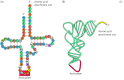
Effigy seven.one
Structure of tRNAs. The structure of yeast phenylalanyl tRNA is illustrated in open "cloverleaf" class (A) to show complementary base pairing. Modified bases are indicated equally mG, methylguanosine; mC, methylcytosine; DHU, dihydrouridine; (more...)
The incorporation of the correctly encoded amino acids into proteins depends on the zipper of each amino acid to an appropriate tRNA, besides every bit on the specificity of codon-anticodon base pairing. The attachment of amino acids to specific tRNAs is mediated by a grouping of enzymes called aminoacyl tRNA synthetases, which were discovered past Paul Zamecnik and Mahlon Hoagland in 1957. Each of these enzymes recognizes a single amino acid, likewise every bit the correct tRNA (or tRNAs) to which that amino acid should exist attached. The reaction proceeds in two steps (Figure vii.2). Showtime, the amino acid is activated past reaction with ATP to course an aminoacyl AMP synthetase intermediate. The activated amino acid is then joined to the 3´ terminus of the tRNA. The aminoacyl tRNA synthetases must exist highly selective enzymes that recognize both private amino acids and specific base sequences that identify the correct acceptor tRNAs. In some cases, the high fidelity of amino acid recognition results in part from a proofreading office by which wrong aminoacyl AMPs are hydrolyzed rather than being joined to tRNA during the second step of the reaction. Recognition of the right tRNA by the aminoacyl tRNA synthetase is too highly selective; the synthetase recognizes specific nucleotide sequences (in most cases including the anticodon) that uniquely identify each species of tRNA.
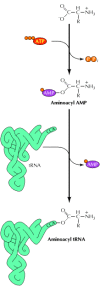
Figure vii.2
Zipper of amino acids to tRNAs. In the first reaction step, the amino acid is joined to AMP, forming an aminoacyl AMP intermediate. In the second step, the amino acrid is transferred to the iii´ CCA terminus of the acceptor tRNA and AMP is released. (more...)
After beingness fastened to tRNA, an amino acrid is aligned on the mRNA template by complementary base of operations pairing between the mRNA codon and the anticodon of the tRNA. Codon-anticodon base pairing is somewhat less stringent than the standard A-U and G-C base pairing discussed in preceding capacity. The significance of this unusual base pairing in codon-anticodon recognition relates to the redundancy of the genetic lawmaking. Of the 64 possible codons, iii are stop codons that signal the termination of translation; the other 61 encode amino acids (run into Table iii.1). Thus, about of the amino acids are specified by more than than one codon. In function, this redundancy results from the attachment of many amino acids to more than one species of tRNA. Due east. coli, for example, comprise well-nigh forty different tRNAs that serve as acceptors for the twenty different amino acids. In addition, some tRNAs are able to recognize more than than one codon in mRNA, equally a outcome of nonstandard base pairing (called wobble) between the tRNA anticodon and the third position of some complementary codons (Figure 7.three). Relaxed base pairing at this position results partly from the formation of G-U base pairs and partly from the modification of guanosine to inosine in the anticodons of several tRNAs during processing (encounter Figure half-dozen.38). Inosine tin base-pair with either C, U, or A in the third position, and then its inclusion in the anticodon allows a single tRNA to recognize three unlike codons in mRNA templates.
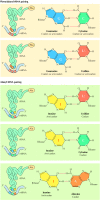
Figure seven.iii
Nonstandard codon-anticodon base pairing. Base of operations pairing at the third codon position is relaxed, allowing G to pair with U, and inosine (I) in the anticodon to pair with U, C, or A. 2 examples of aberrant base pairing, allowing phenylalanyl (Phe) tRNA (more...)
The Ribosome
Ribosomes are the sites of poly peptide synthesis in both prokaryotic and eukaryotic cells. First characterized as particles detected by ultracentrifugation of prison cell lysates, ribosomes are usually designated co-ordinate to their rates of sedimentation: 70S for bacterial ribosomes and 80S for the somewhat larger ribosomes of eukaryotic cells. Both prokaryotic and eukaryotic ribosomes are composed of two distinct subunits, each containing characteristic proteins and rRNAs. The fact that cells typically contain many ribosomes reflects the key importance of protein synthesis in prison cell metabolism. E. coli, for case, contain about 20,000 ribosomes, which account for approximately 25% of the dry out weight of the cell, and apace growing mammalian cells contain virtually 10 meg ribosomes.
The full general structures of prokaryotic and eukaryotic ribosomes are similar, although they differ in some details (Effigy 7.4). The small subunit (designated 30S) of E. coli ribosomes consists of the 16S rRNA and 21 proteins; the large subunit (50S) is composed of the 23S and 5S rRNAs and 34 proteins. Each ribosome contains 1 copy of the rRNAs and one copy of each of the ribosomal proteins, with one exception: One protein of the 50S subunit is present in four copies. The subunits of eukaryotic ribosomes are larger and contain more proteins than their prokaryotic counterparts have. The small subunit (40S) of eukaryotic ribosomes is composed of the 18S rRNA and approximately thirty proteins; the large subunit (60S) contains the 28S, 5.8S, and 5S rRNAs and about 45 proteins.

Figure 7.4
Ribosome structure. (A) Electron micrograph of E. coli 50S ribosomal subunits. (B–C) High resolution X-ray crystal structures of 30S (B) and 50S (C) ribosomal subunits. (D) Model of ribosome construction. (E) Components of prokaryotic and eukaryotic (more...)
A noteworthy feature of ribosomes is that they can be formed in vitro by cocky-associates of their RNA and protein constituents. As first described in 1968 by Masayasu Nomura, purified ribosomal proteins and rRNAs tin be mixed together and, under appropriate atmospheric condition, will reform a functional ribosome. Although ribosome assembly in vivo (peculiarly in eukaryotic cells) is considerably more complicated, the ability of ribosomes to self-assemble in vitro has provided an important experimental tool, allowing analysis of the roles of individual proteins and rRNAs.
Similar tRNAs, rRNAs class feature secondary structures by complementary base pairing (Figure vii.5). In association with ribosomal proteins the rRNAs fold farther, into distinct three-dimensional structures. Initially, rRNAs were thought to play a structural role, providing a scaffold upon which ribosomal proteins assemble. However, with the discovery of the catalytic activeness of other RNA molecules (e.g., RNase P and the self-splicing introns discussed in Chapter 6), the possible catalytic part of rRNA became widely considered. Consistent with this hypothesis, rRNAs were found to exist absolutely required for the in vitro assembly of functional ribosomes. On the other mitt, the omission of many ribosomal proteins resulted in a decrease, merely not a complete loss, of ribosome activity.

Figure 7.5
The structure of 16S rRNA. Complementary base pairing results in the formation of a distinct secondary structure. (From S. Stern, T. Powers, 50.-I. Changchien and H. F. Noller, 1989. Science 244: 783.)
Directly evidence for the catalytic activity of rRNA offset came from experiments of Harry Noller and his colleagues in 1992. These investigators demonstrated that the large ribosomal subunit is able to catalyze the formation of peptide bonds (the peptidyl transferase reaction) even afterward approximately 95% of the ribosomal proteins take been removed by standard protein extraction procedures. In contrast, treatment with RNase completely abolishes peptide bond formation, providing potent support for the hypothesis that the formation of a peptide bail is an RNA-catalyzed reaction. Further studies have confirmed and extended these results by demonstrating that the peptidyl transferase reaction can be catalyzed past constructed fragments of 23S rRNA in the total absenteeism of any ribosomal poly peptide. Thus, the central reaction of poly peptide synthesis is catalyzed by ribosomal RNA. Rather than being the primary catalytic constituents of ribosomes, ribosomal proteins are now thought to facilitate proper folding of the rRNA and to enhance ribosome part past properly positioning the tRNAs.
The direct involvement of rRNA in the peptidyl transferase reaction has important evolutionary implications. RNAs are thought to take been the showtime cocky-replicating macromolecules (run into Chapter 1). This notion is strongly supported by the fact that ribozymes, such as RNase P and self-splicing introns, can catalyze reactions that involve RNA substrates. The function of rRNA in the formation of peptide bonds extends the catalytic activities of RNA across cocky-replication to direct interest in poly peptide synthesis. Additional studies indicate that the Tetrahymena rRNA ribozyme can catalyze the attachment of amino acids to RNA, lending credence to the possibility that the original aminoacyl tRNA synthetases were RNAs rather than proteins. The power of RNA molecules to catalyze the reactions required for protein synthesis equally well equally for self-replication may provide an important link for agreement the early evolution of cells.
The Organisation of mRNAs and the Initiation of Translation
Although the mechanisms of protein synthesis in prokaryotic and eukaryotic cells are similar, there are likewise differences, particularly in the signals that determine the positions at which synthesis of a polypeptide chain is initiated on an mRNA template (Figure 7.6). Translation does not simply brainstorm at the 5´ cease of the mRNA; information technology starts at specific initiation sites. The 5´ terminal portions of both prokaryotic and eukaryotic mRNAs are therefore noncoding sequences, referred to every bit v´ untranslated regions. Eukaryotic mRNAs usually encode just a single polypeptide chain, but many prokaryotic mRNAs encode multiple polypeptides that are synthesized independently from distinct initiation sites. For example, the East. coli lac operon consists of iii genes that are translated from the same mRNA (see Figure 6.viii). Messenger RNAs that encode multiple polypeptides are called polycistronic, whereas monocistronic mRNAs encode a unmarried polypeptide chain. Finally, both prokaryotic and eukaryotic mRNAs terminate in noncoding three´ untranslated regions.
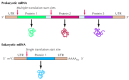
Effigy 7.6
Prokaryotic and eukaryotic mRNAs. Both prokaryotic and eukaryotic mRNAs contain untranslated regions (UTRs) at their 5´ and 3´ ends. Eukaryotic mRNAs besides contain 5´ seven-methylguanosine (grandviiG) caps and iii´ poly-A tails. Prokaryotic (more...)
In both prokaryotic and eukaryotic cells, translation always initiates with the amino acid methionine, unremarkably encoded by AUG. Alternative initiation codons, such as GUG, are used occasionally in bacteria, simply when they occur at the beginning of a polypeptide chain, these codons straight the incorporation of methionine rather than of the amino acrid they commonly encode (GUG normally encodes valine). In most bacteria, protein synthesis is initiated with a modified methionine residue (N-formylmethionine), whereas unmodified methionines initiate protein synthesis in eukaryotes (except in mitochondria and chloroplasts, whose ribosomes resemble those of bacteria).
The signals that identify initiation codons are unlike in prokaryotic and eukaryotic cells, consequent with the singled-out functions of polycistronic and monocistronic mRNAs (Figure 7.7). Initiation codons in bacterial mRNAs are preceded by a specific sequence (chosen a Shine-Delgarno sequence, later its discoverers) that aligns the mRNA on the ribosome for translation by base of operations-pairing with a complementary sequence near the iii´ terminus of 16S rRNA. This base-pairing interaction enables bacterial ribosomes to initiate translation not simply at the 5´ terminate of an mRNA but also at the internal initiation sites of polycistronic messages. In contrast, ribosomes recognize most eukaryotic mRNAs by binding to the vii-methylguanosine cap at their 5´ terminus (encounter Effigy 6.39). The ribosomes then browse downstream of the 5´ cap until they see an AUG initiation codon. Sequences that surroundings AUGs affect the efficiency of initiation, and so in many cases the first AUG in the mRNA is bypassed and translation initiates at an AUG farther downstream. However, eukaryotic mRNAs accept no sequence equivalent to the Smoothen-Delgarno sequence of prokaryotic mRNAs. Translation of eukaryotic mRNAs is instead initiated at a site adamant by scanning from the v´ terminus, consistent with their functions as monocistronic messages that encode only single polypeptides.

Effigy seven.7
Signals for translation initiation. Initiation sites in prokaryotic mRNAs are characterized by a Polish-Delgarno sequence that precedes the AUG initiation codon. Base of operations pairing between the Smoothen-Delgarno sequence and a complementary sequence near the iii´ (more...)
The Procedure of Translation
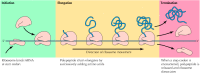
Translation is generally divided into three stages: initiation, elongation, and termination (Figure seven.viii). In both prokaryotes and eukaryotes the first footstep of the initiation stage is the binding of a specific initiator methionyl tRNA and the mRNA to the small ribosomal subunit. The large ribosomal subunit then joins the complex, forming a functional ribosome on which elongation of the polypeptide chain gain. A number of specific nonribosomal proteins are besides required for the various stages of the translation process (Tabular array 7.1).
The first translation step in bacteria is the bounden of three initiation factors (IF-one, IF-2, and IF-3) to the 30S ribosomal subunit (Figure seven.9). The mRNA and initiator Due north-formylmethionyl tRNA then join the circuitous, with IF-2 (which is leap to GTP) specifically recognizing the initiator tRNA. IF-3 is then released, allowing a 50S ribosomal subunit to acquaintance with the complex. This association triggers the hydrolysis of GTP bound to IF-2, which leads to the release of IF-i and IF-ii (bound to Gdp). The result is the formation of a 70S initiation complex (with mRNA and initiator tRNA jump to the ribosome) that is ready to begin peptide bond formation during the elongation stage of translation.
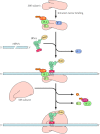
Figure 7.ix
Initiation of translation in leaner. Iii initiation factors (IF-1, IF-ii, and IF-3) beginning bind to the 30S ribosomal subunit. This step is followed past binding of the mRNA and the initiator N-formylmethionyl (fMet) tRNA, which is recognized by IF-2 jump (more than...)
Initiation in eukaryotes is more complicated and requires at to the lowest degree ten proteins (each consisting of multiple polypeptide chains), which are designated eIFs (eukaryotic initiation factors; see Table 7.one). The factors eIF-1, eIF-1A, and eIF-3 bind to the 40S ribosomal subunit, and eIF-ii (in a circuitous with GTP) associates with the initiator methionyl tRNA (Figure vii.10). The mRNA is recognized and brought to the ribosome by the eIF-iv group of factors. The five´ cap of the mRNA is recognized by eIF-4E. Another factor, eIF-4G, binds to both eIF-4E and to a protein (poly-A binding protein or PABP) associated with the poly-A tail at the 3' end of the mRNA. Eukaryotic initiation factors thus recognize both the five' and iii' ends of mRNAs, accounting for the stimulatory event of polyadenylation on translation. The initiation factors eIF-4E and eIF-4G, in clan with eIF-4A and eIF-4B, then bring the mRNA to the 40S ribosomal subunit, with eIF-4G interacting with eIF-3. The 40S ribosomal subunit, in association with the bound methionyl tRNA and eIFs, so scans the mRNA to identify the AUG initiation codon. When the AUG codon is reached, eIF-five triggers the hydrolysis of GTP jump to eIF-2. Initiation factors (including eIF-ii bound to GDP) are then released, and a 60S subunit binds to the 40S subunit to form the 80S initiation complex of eukaryotic cells.

Effigy seven.10
Initiation of translation in eukaryotic cells. Initiation factors eIF-3, eIF-i, and eIF-1A bind to the 40S ribosomal subunit. The initiator methionyl tRNA is brought to the ribosome by eIF-2 (complexed to GTP), and the mRNA by eIF-4E (which binds to the (more than...)
After the initiation complex has formed, translation gain by elongation of the polypeptide chain. The mechanism of elongation in prokaryotic and eukaryotic cells is very similar (Effigy 7.11). The ribosome has three sites for tRNA binding, designated the P (peptidyl), A (aminoacyl), and E (leave) sites. The initiator methionyl tRNA is bound at the P site. The outset pace in elongation is the bounden of the side by side aminoacyl tRNA to the A site by pairing with the second codon of the mRNA. The aminoacyl tRNA is escorted to the ribosome past an elongation gene (EF-Tu in prokaryotes, eEF-1α in eukaryotes), which is complexed to GTP. The GTP is hydrolyzed to Gdp as the correct aminoacyl tRNA is inserted into the A site of the ribosome and the elongation factor bound to GDP is released. The requirement for hydrolysis of GTP before EF-Tu or eEF-1α is released from the ribosome is the charge per unit-limiting pace in elongation and provides a time interval during which an wrong aminoacyl tRNA, which would bind less strongly to the mRNA codon, can dissociate from the ribosome rather than being used for protein synthesis. Thus, the expenditure of a high-free energy GTP at this step is an important contribution to accurate protein synthesis; it allows time for proofreading of the codon-anticodon pairing before the peptide bail forms.
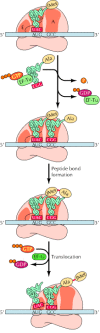
Figure vii.eleven
Elongation phase of translation. The ribosome has 3 tRNA-bounden sites, designated P (peptidyl), A (aminoacyl), and E (exit). The initiating Northward-formylmethionyl tRNA is positioned in the P site, leaving an empty A site. The 2nd aminoacyl tRNA (east.one thousand., (more...)
Once EF-Tu (or eEF-1α) has left the ribosome, a peptide bail can be formed between the initiator methionyl tRNA at the P site and the 2d aminoacyl tRNA at the A site. This reaction is catalyzed by the large ribosomal subunit, with the rRNA playing a critical function (as already discussed). The result is the transfer of methionine to the aminoacyl tRNA at the A site of the ribosome, forming a peptidyl tRNA at this position and leaving the uncharged initiator tRNA at the P site. The adjacent footstep in elongation is translocation, which requires another elongation factor (EF-G in prokaryotes, eEF-2 in eukaryotes) and is over again coupled to GTP hydrolysis. During translocation, the ribosome moves iii nucleotides forth the mRNA, positioning the next codon in an empty A site. This stride translocates the peptidyl tRNA from the A site to the P site, and the uncharged tRNA from the P site to the E site. The ribosome is then left with a peptidyl tRNA spring at the P site, and an empty A site. The binding of a new aminoacyl tRNA to the A site then induces the release of the uncharged tRNA from the E site, leaving the ribosome fix for insertion of the side by side amino acid in the growing polypeptide concatenation.
Every bit elongation continues, the EF-Tu (or eEF-1α) that is released from the ribosome bound to Gross domestic product must exist reconverted to its GTP class (Figure 7.12). This conversion requires a third elongation cistron, EF-Ts (eEF-1βγ in eukaryotes), which binds to the EF-Tu/GDP complex and promotes the exchange of bound Gross domestic product for GTP. This commutation results in the regeneration of EF-Tu/GTP, which is now set to escort a new aminoacyl tRNA to the A site of the ribosome, commencement a new wheel of elongation. The regulation of EF-Tu by GTP binding and hydrolysis illustrates a common ways of the regulation of protein activities. As volition be discussed in later chapters, similar mechanisms control the activities of a wide diversity of proteins involved in the regulation of cell growth and differentiation, too as in poly peptide transport and secretion.
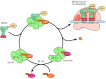
Figure vii.12
Regeneration of EF-Tu/GTP. EF-Tu complexed to GTP escorts the aminoacyl tRNA to the ribosome. The bound GTP is hydrolyzed every bit the right tRNA is inserted, then EF-Tu complexed to GDP is released. The EF-Tu/Gdp circuitous is inactive and unable to bind another (more...)
Elongation of the polypeptide concatenation continues until a stop codon (UAA, UAG, or UGA) is translocated into the A site of the ribosome. Cells do not incorporate tRNAs with anticodons complementary to these termination signals; instead, they accept release factors that recognize the signals and terminate protein synthesis (Figure 7.thirteen). Prokaryotic cells contain two release factors that recognize termination codons: RF-one recognizes UAA or UAG, and RF-2 recognizes UAA or UGA (see Table 7.1). In eukaryotic cells a single release factor (eRF-1) recognizes all three termination codons. Both prokaryotic and eukaryotic cells besides contain release factors (RF-iii and eRF-three, respectively) that do not recognize specific termination codons but act together with RF-1 (or eRF-1) and RF-two. The release factors bind to a termination codon at the A site and stimulate hydrolysis of the bond between the tRNA and the polypeptide chain at the P site, resulting in release of the completed polypeptide from the ribosome. The tRNA is then released, and the ribosomal subunits and the mRNA template dissociate.
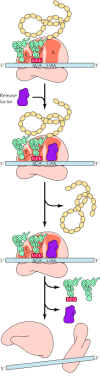
Figure 7.thirteen
Termination of translation. A termination codon (e.1000., UAA) at the A site is recognized by a release factor rather than by a tRNA. The result is the release of the completed polypeptide chain, followed by the dissociation of tRNA and mRNA from the ribosome. (more...)
Messenger RNAs can be translated simultaneously by several ribosomes in both prokaryotic and eukaryotic cells. Once one ribosome has moved away from the initiation site, another can bind to the mRNA and begin synthesis of a new polypeptide concatenation. Thus, mRNAs are usually translated by a series of ribosomes, spaced at intervals of about 100 to 200 nucleotides (Effigy 7.14). The grouping of ribosomes bound to an mRNA molecule is called a polyribosome, or polysome. Each ribosome within the group functions independently to synthesize a carve up polypeptide chain.
Figure vii.14
Polysomes. Messenger RNAs are translated by a series of multiple ribosomes (a polysome). (A) Electron micrograph of a eukaryotic polysome. (B) Schematic of a generalized poly-some. Notation that the ribosomes closer to the 3´ end of the mRNA have (more...)
Regulation of Translation
Although transcription is the primary level at which gene expression is controlled, the translation of mRNAs is also regulated in both prokaryotic and eukaryotic cells. I machinery of translational regulation is the binding of repressor proteins, which block translation, to specific mRNA sequences. The all-time understood instance of this mechanism in eukaryotic cells is regulation of the synthesis of ferritin, a poly peptide that stores fe within the cell. The translation of ferritin mRNA is regulated by the supply of iron: More than ferritin is synthesized if iron is abundant (Figure 7.fifteen). This regulation is mediated by a protein which (in the absence of iron) binds to a sequence (the iron response chemical element, or IRE) in the 5´ untranslated region of ferritin mRNA, blocking its translation. In the presence of iron, the repressor no longer binds to the IRE and ferritin translation is able to keep.

Figure seven.15
Translational regulation of ferritin. The mRNA contains an atomic number 26 response element (IRE) near its 5´ cap. In the presence of acceptable supplies of iron, translation of the mRNA gain commonly. If atomic number 26 is scarce, however, a poly peptide (called the (more...)
It is interesting to annotation that the regulation of translation of ferritin mRNA past iron is similar to the regulation of transferrin receptor mRNA stability, which was discussed in the previous chapter (meet Figure 6.48). Namely, the stability of transferrin receptor mRNA is regulated by poly peptide binding to an IRE in its 3´ untranslated region. The same protein binds to the IREs of both ferritin and transferrin receptor mRNAs. However, the consequences of protein binding to the 2 IREs are quite dissimilar. Poly peptide jump to the transferrin receptor IRE protects the mRNA from deposition rather than inhibiting its translation. These distinct effects presumably result from the different locations of the IRE in the two mRNAs. To function as a repressor-binding site, the IRE must be located within 70 nucleotides of the 5´ cap of ferritin mRNA, suggesting that protein binding to the IRE blocks translation past interfering with cap recognition and binding of the 40S ribosomal subunit. Rather than inhibiting translation, poly peptide bounden to the same sequence in the 3´ untranslated region of transferrin receptor mRNA protects the mRNA from nuclease deposition. Binding of the same regulatory protein to dissimilar sites on mRNA molecules can thus have distinct effects on gene expression, in one instance inhibiting translation and in the other stabilizing the mRNA to increase protein synthesis.
Another mechanism of translational regulation in eukaryotic cells, resulting in global furnishings on overall translational activity rather than on the translation of specific mRNAs, involves modulation of the activity of initiation factors, peculiarly eIF-2. Every bit already discussed, eIF-2 (complexed with GTP) binds to the initiator methionyl tRNA, bringing information technology to the ribosome. The subsequent release of eIF-2 is accompanied by GTP hydrolysis, leaving eIF-ii as an inactive GDP complex. To participate in another bicycle of initiation, the eIF-2/GTP complex must exist regenerated by the substitution of bound GDP for GTP. This exchange is mediated by another factor, eIF-2B. The command of eIF-2 activity by GTP binding and hydrolysis is thus similar to that of EF-Tu (see Figure 7.12). All the same, the regulation of eIF-2 provides a critical control bespeak in a variety of eukaryotic cells. In item, eIF-ii tin be phosphorylated by regulatory protein kinases. This phosphorylation blocks the exchange of jump Gross domestic product for GTP, thereby inhibiting initiation of translation. One type of jail cell in which such phosphorylation occurs is the reticulocyte, which is devoted to the synthesis of hemoglobin (Figure seven.16). The translation of globin mRNA is controlled by the availability of heme: The mRNA is translated merely if adequate heme is available to course functional hemoglobin molecules. In the absence of heme, a poly peptide kinase that phosphorylates eIF-2 is activated, and further translation is inhibited. Similar mechanisms take been found to command poly peptide synthesis in other prison cell types, particularly virus-infected cells in which viral protein synthesis is inhibited by interferon.
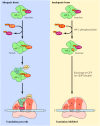
Figure 7.16
Regulation of translation by phosphorylation of eIF-two. Translation in reticulocytes (which is devoted to synthesis of hemoglobin) is controlled by the supply of heme, which regulates the activity of eIF-2. The active form of eIF-2 (complexed with GTP) (more...)
Other studies have implicated eIF-4E, which binds to the 5´ cap of mRNAs, as a translational regulatory poly peptide. For example, the hormone insulin stimulates protein synthesis in adipocytes and muscle cells. This effect of insulin is mediated, at least in part, by phosphorylation of proteins associated with eIF-4E, resulting in stimulation of eIF-4E activity and increased rates of translational initiation.
Translational regulation is particularly important during early development. As discussed in Affiliate vi, a multifariousness of mRNAs are stored in oocytes in an untranslated course; the translation of these stored mRNAs is activated at fertilization or later stages of development. One machinery of such translational regulation is the controlled polyadenylation of oocyte mRNAs. Many untranslated mRNAs are stored in oocytes with short poly-A tails (approximately twenty nucleotides). These stored mRNAs are subsequently recruited for translation at the appropriate stage of development by the lengthening of their poly-A tails to several hundred nucleotides. In addition, the translation of some mRNAs during development appears to be regulated by repressor proteins that bind to specific sequences in their three´ untranslated regions. These regulatory proteins may also direct mRNAs to specific regions of eggs or embryos, allowing localized synthesis of the encoded proteins during embryonic development.
Box
Key Experiment: Catalytic Role of Ribosomal RNA.
Box
Molecular Medicine: Antibiotics and Protein Synthesis.

Is Mrna Template For Protein Production,
Source: https://www.ncbi.nlm.nih.gov/books/NBK9849/
Posted by: shawspreorke.blogspot.com
0 Response to "Is Mrna Template For Protein Production"
Post a Comment